


Context Tuning
Context Tuning for Enterprise Data
Published: July 23, 2026
Share this post



Context is becoming the most valuable commodity in modern AI. No surprise, then, that it's the hottest topic in the field currently. From interpreting intent to planning tasks and getting work done, context is what turns tokens into real ROI. Unfortunately, most of that context is scattered across an organization — spread over disparate sources or simply locked in people's heads. The challenge, then, is to collect and organize it in a useful way. That is hard to do in a single shot. Instead, organizations need a systematic process to build and refine their context incrementally, over time.
This blog treats context tuning as an ongoing challenge for enterprise data. We start with how Tursio infers context in the first place, then look at where that falls short once people begin using it — and how we proactively gauge the quality of the context graph, a kind of self-awareness. Next, we look at how to apply business nuances and validate that they work correctly. This can't be a one-time exercise; it must run continuously, because both data and business context keep evolving. We then turn to the operational side: how to test context changes in bulk and deploy them with zero downtime. Finally, we describe the context-tuning service that the Tursio team provides as part of our product offering — our version of a forward-deployed engineering (FDE) model.
Data sources and tables in the above hierarchical graph connect to each other through join relationships, while attributes form non-overlapping sets linked to each entity. We infer this graph from database schemas (tables, columns, and so on), constraints (e.g., primary keys and PK–FK relationships), statistics (e.g., inclusion dependencies), and past query history (custom measures, aliases, and so on). We also infer certain special aggregates — for example, count-distinct on identifier columns, or symmetric aggregates on measures in a dimension table.
Later, during query processing, we identify the subgraph relevant to the question, construct the join tree, attach additional query operators to build a query plan, rewrite that plan to satisfy all constraints, and finally serialize it into the relevant SQL and code. The details of query processing are beyond the scope of this blog; from here on, we focus on tuning the context structure itself.
Tursio brings many of these business artifacts into the same context structure. First, it lets you connect logical views just like any other table and organize their columns into dimensions and measures for clearer business interpretation. Second, it loads existing vocabulary and semantics from BI reports — Power BI, VPAX, SAP BW, and others. All these merge into the same context graph, and you keep full control to refine them further. You can also connect governance platforms like Purview and pull in classifications, glossary terms, and data-asset or business-concept attributes. Tursio inherits the same scoping and access controls those platforms already enforce.
Finally, you can supply data specifications and other manuals as PDFs; Tursio extracts the unstructured information and attaches it to the relevant nodes in the graph. The goal throughout is to enrich the context graph from artifacts the business already has.
Beyond enriching the graph, Tursio also lets you add CSVs, Excel files, and PDFs as data sources in their own right — extracting structured data from them and linking it to other sources. For example, a team might keep operational data in a database and its business analysis in an Excel file; they can upload the spreadsheet to Tursio and link it back to the database to answer cross-cutting questions.
We face a two-sided world: enterprise data on one side, and people's knowledge about that data on the other. Trying to capture knowledge about every piece of data is futile, since much of it is never used. Mapping every piece of knowledge back to some data makes just as little sense, since data keeps evolving and may no longer match older knowledge.

So instead of trying to understand everything, we focus on what is ambiguous and get it clarified. This starts with a kind of self-awareness: Tursio continually gauges the quality of its own context graph and flags the parts it is least sure about. During training, Tursio compiles a list of ambiguities — across tables, columns, relationships, and more — and surfaces them for users to clarify. The idea is to fix only what is unclear and steadily reduce the overall ambiguity in the system. Users provide these clarifications as business rules — for example, an enforcer rule to mandate a certain behavior for a table or column, or a hierarchical rule to establish implicit value-based hierarchies between columns.

New business rules change how the system behaves, and they often conflict with each other, so Tursio lets you validate a rule's impact before applying it. You can “flight” a rule against a few sample questions and check the results. This keeps rule-testing incremental and avoids the confusing situations that arise when multiple rules collide with each other.
Admins can filter down to the questions that received feedback, inspect their query plans, and apply whatever tuning is needed. They can also maintain a set of saved queries and "flight" all of them at once — a batch job that tests every query and produces a single report. The goal is to make testing and validation easier as the set of saved queries grows.
Finally, tuning and training are experimental by nature, and the production workload must keep running throughout. Tursio ensures zero downtime by letting admins clone any connection into a dev copy, apply all the tuning and training there, and then merge the dev connection back into production seamlessly once they are satisfied. This means admins can run context tuning as often as they need, without disrupting production.
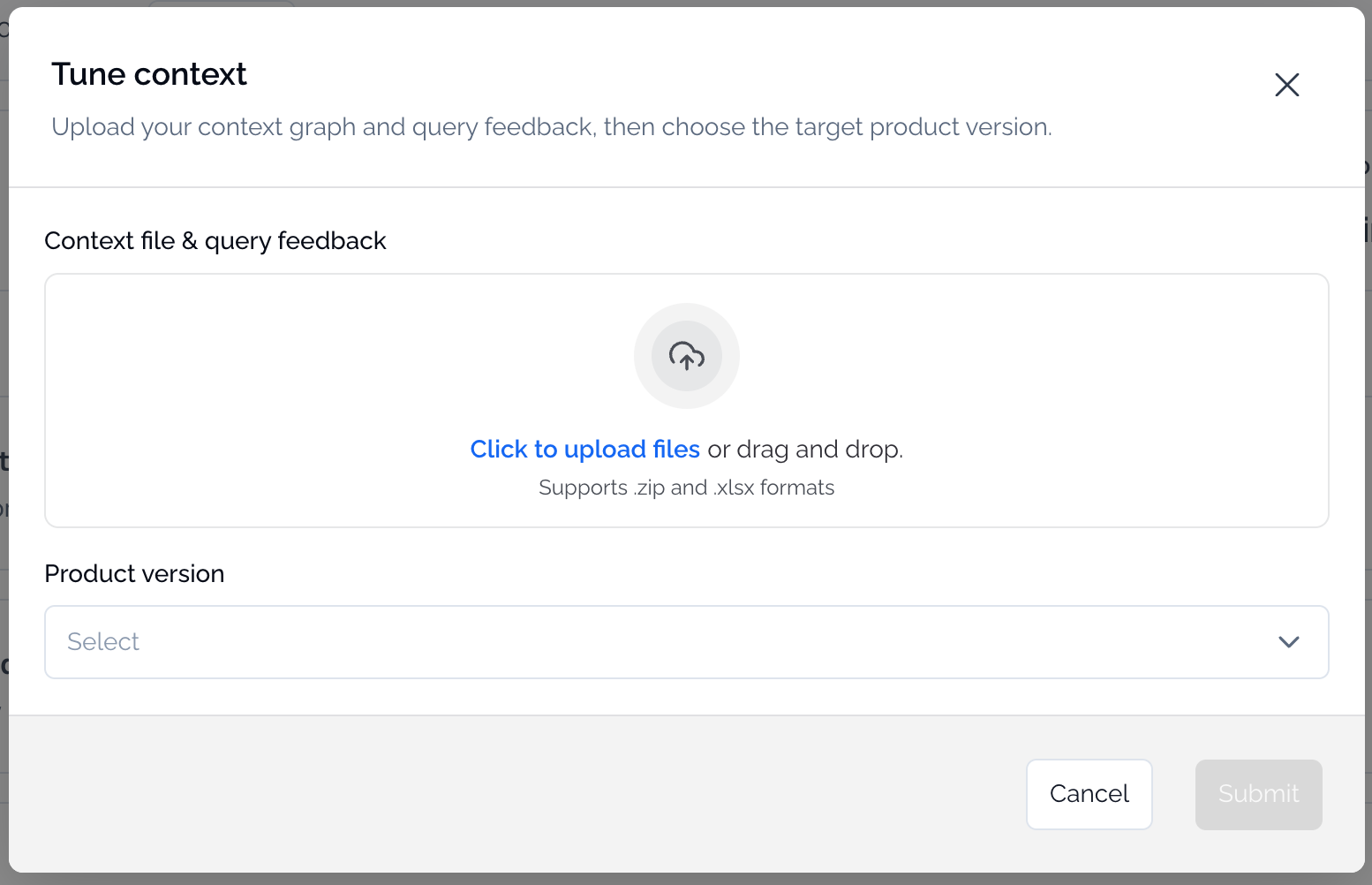
To ease that burden, the Tursio team offers context tuning as a value-added service. Customers export a context graph and query history from their installation and hand it to us. We use the exported graph to simulate a synthetic dataset with similar characteristics, then use the feedback in the query history to tune the context through an internal context tuner. We return the tuned context, along with a validation report, for the customer to import. Customers can submit as many tuning jobs as they need, and our internal tooling delivers each tuned version within a 24-hour turnaround.
In summary, getting context right is critical for modern AI, and it is not something you do once and then walk away. Context is scattered; it lives as much in people's heads as in databases, and both keep changing — so tuning must be continuous, incremental, and grounded in how people use the system. This is the harder, less visible half of making AI useful on enterprise data, and it is where much of the real value is won. Tursio provides an organized way to do this work — inferring the initial context, folding in business artifacts and human knowledge, and refining it through a feedback loop — so an organization's context stays trustworthy and usable across the board.
This blog treats context tuning as an ongoing challenge for enterprise data. We start with how Tursio infers context in the first place, then look at where that falls short once people begin using it — and how we proactively gauge the quality of the context graph, a kind of self-awareness. Next, we look at how to apply business nuances and validate that they work correctly. This can't be a one-time exercise; it must run continuously, because both data and business context keep evolving. We then turn to the operational side: how to test context changes in bulk and deploy them with zero downtime. Finally, we describe the context-tuning service that the Tursio team provides as part of our product offering — our version of a forward-deployed engineering (FDE) model.
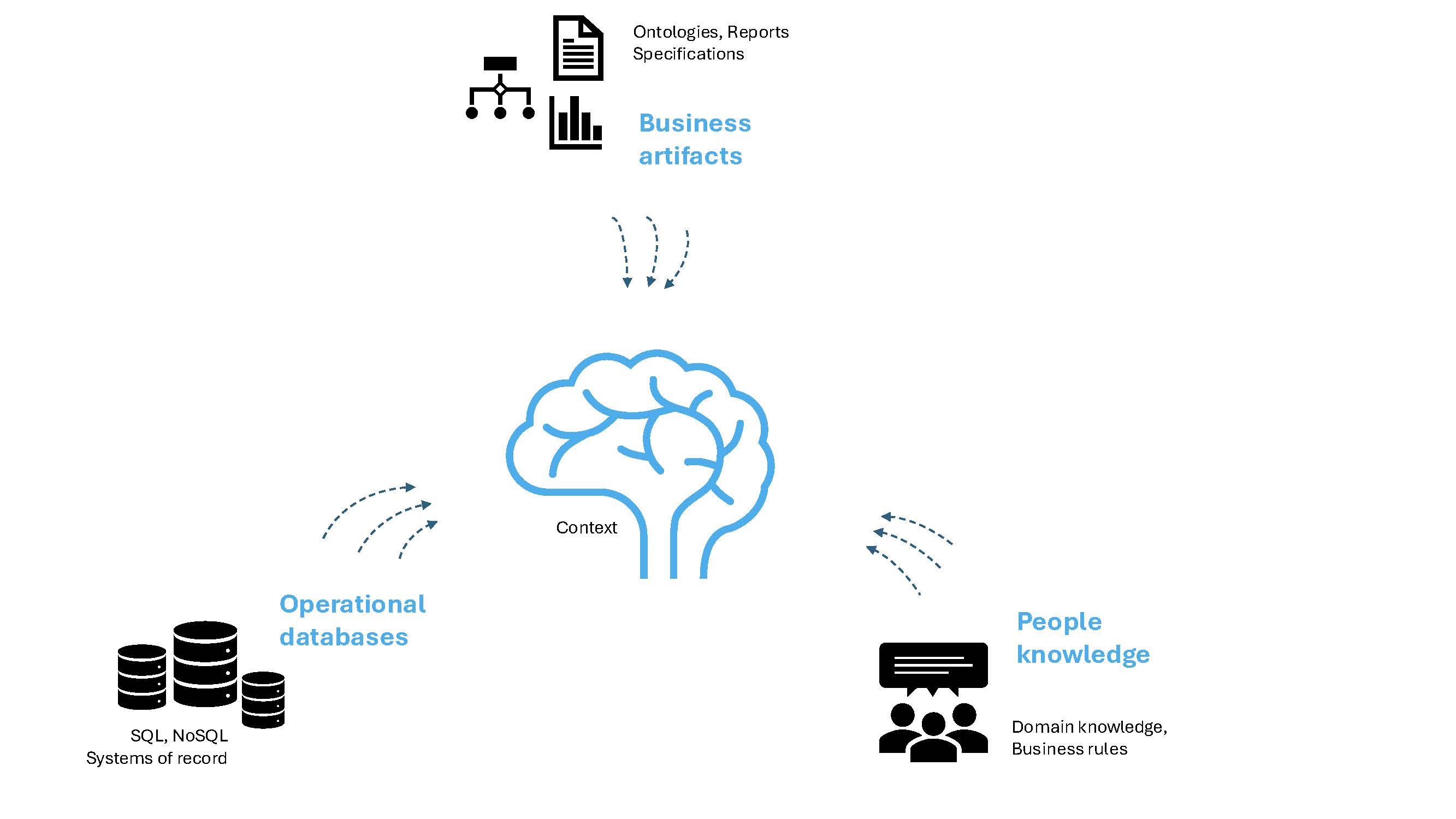
Figure 1: Building the organizational context to make AI work and translate tokens to ROI.
Organizing context into a structure
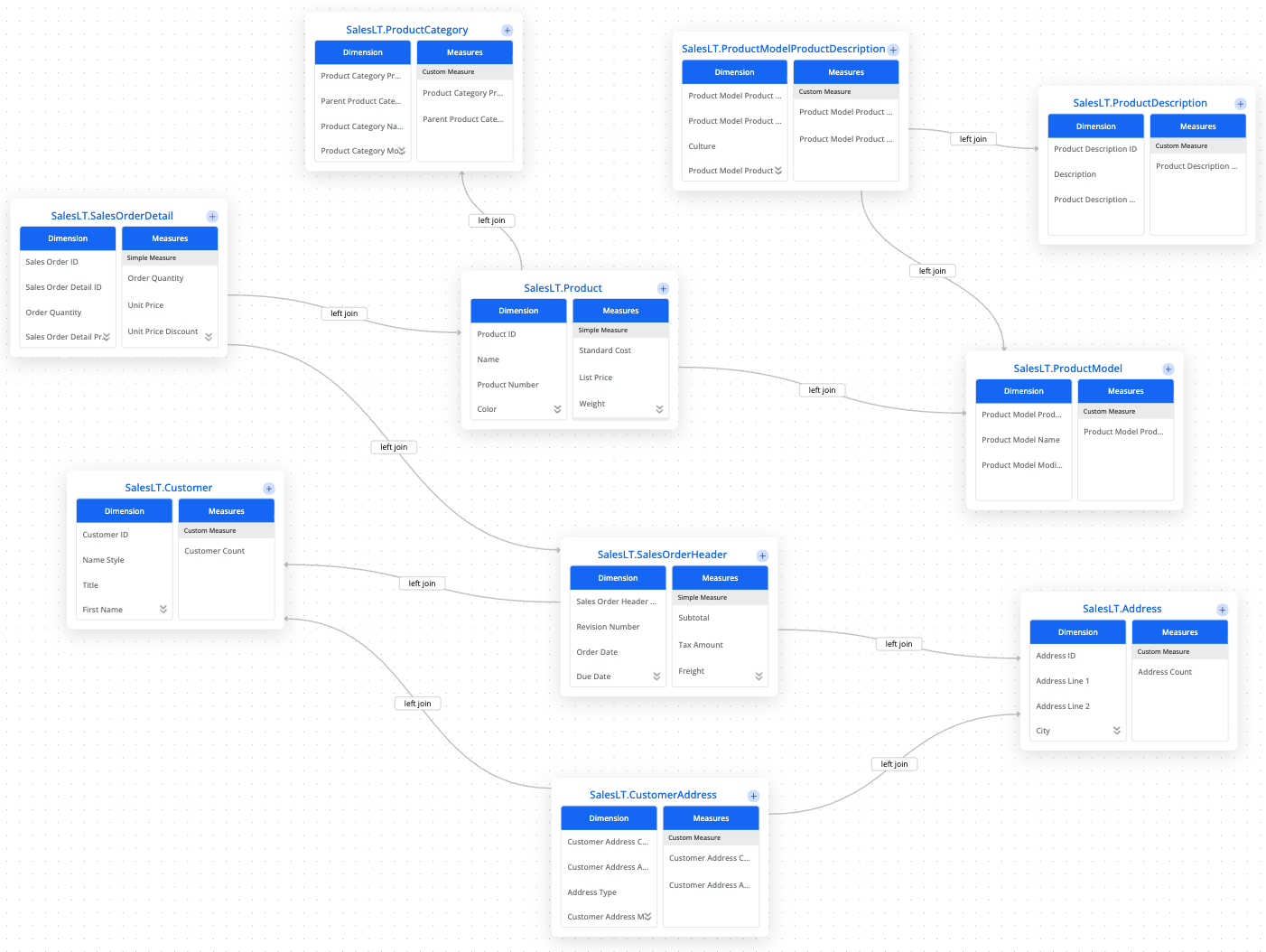
At Tursio, we organize the context into a structure that can be populated and retrieved systematically for query processing. It is essentially a hierarchical graph. The first level maps to data sources — connections to SQL or NoSQL databases, or systems of record. The second level maps to the tables, views, or entities in each source. The third maps to the attributes in each entity. Finally, each entity carries a set of types (data type, value type, ontology type, and so on) and rules (enforcer, priority, hierarchy, and so on).Data sources and tables in the above hierarchical graph connect to each other through join relationships, while attributes form non-overlapping sets linked to each entity. We infer this graph from database schemas (tables, columns, and so on), constraints (e.g., primary keys and PK–FK relationships), statistics (e.g., inclusion dependencies), and past query history (custom measures, aliases, and so on). We also infer certain special aggregates — for example, count-distinct on identifier columns, or symmetric aggregates on measures in a dimension table.
Figure 2: Data context maps naturally to a multi-level graph structure.
Later, during query processing, we identify the subgraph relevant to the question, construct the join tree, attach additional query operators to build a query plan, rewrite that plan to satisfy all constraints, and finally serialize it into the relevant SQL and code. The details of query processing are beyond the scope of this blog; from here on, we focus on tuning the context structure itself.
Tuning with business artifacts
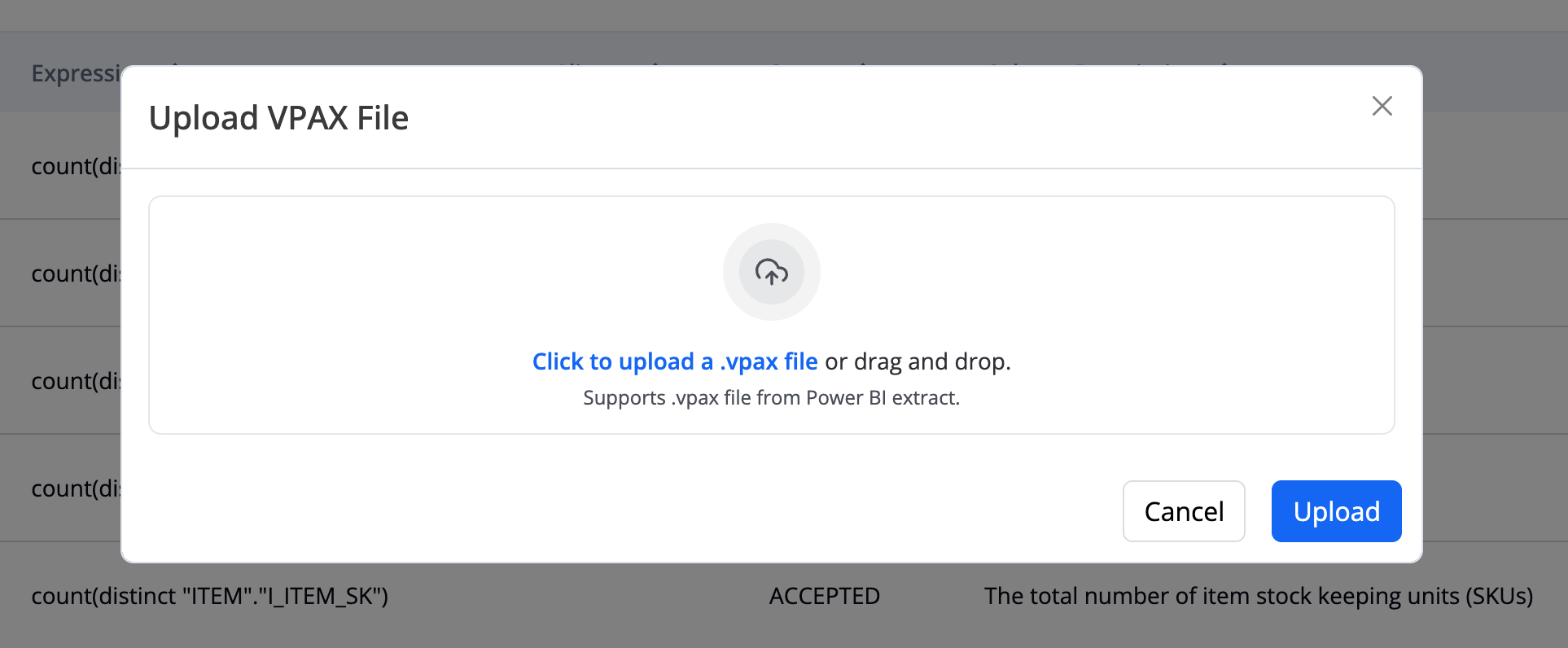
Businesses already have a mountain of context lying around — special data views they have created, BI reports they have built, governance guardrails they have designed, or specification documents they have written.Tursio brings many of these business artifacts into the same context structure. First, it lets you connect logical views just like any other table and organize their columns into dimensions and measures for clearer business interpretation. Second, it loads existing vocabulary and semantics from BI reports — Power BI, VPAX, SAP BW, and others. All these merge into the same context graph, and you keep full control to refine them further. You can also connect governance platforms like Purview and pull in classifications, glossary terms, and data-asset or business-concept attributes. Tursio inherits the same scoping and access controls those platforms already enforce.
Figure 3: Business artifacts from Power BI must be aligned with the same context structure.
Finally, you can supply data specifications and other manuals as PDFs; Tursio extracts the unstructured information and attaches it to the relevant nodes in the graph. The goal throughout is to enrich the context graph from artifacts the business already has.
Beyond enriching the graph, Tursio also lets you add CSVs, Excel files, and PDFs as data sources in their own right — extracting structured data from them and linking it to other sources. For example, a team might keep operational data in a database and its business analysis in an Excel file; they can upload the spreadsheet to Tursio and link it back to the database to answer cross-cutting questions.
Tuning with people’s knowledge
Most organizations hold far more knowledge in people's heads than in any business artifact. It is simply too hard to document every procedure and nuance, so companies rely on the people who know how the business runs. This knowledge is the real goldmine, but capturing it from someone's head into the context graph is hard.We face a two-sided world: enterprise data on one side, and people's knowledge about that data on the other. Trying to capture knowledge about every piece of data is futile, since much of it is never used. Mapping every piece of knowledge back to some data makes just as little sense, since data keeps evolving and may no longer match older knowledge.
Figure 4: Focusing on what's ambiguous can accelerate the incorporation of people's knowledge.
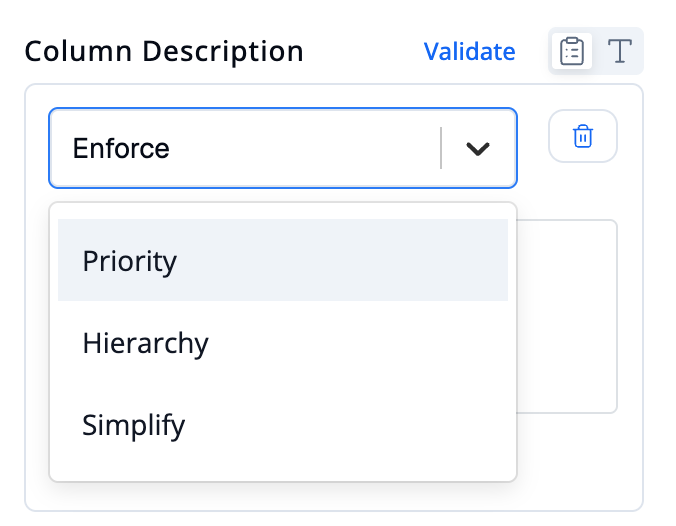
So instead of trying to understand everything, we focus on what is ambiguous and get it clarified. This starts with a kind of self-awareness: Tursio continually gauges the quality of its own context graph and flags the parts it is least sure about. During training, Tursio compiles a list of ambiguities — across tables, columns, relationships, and more — and surfaces them for users to clarify. The idea is to fix only what is unclear and steadily reduce the overall ambiguity in the system. Users provide these clarifications as business rules — for example, an enforcer rule to mandate a certain behavior for a table or column, or a hierarchical rule to establish implicit value-based hierarchies between columns.
Figure 5: Business rules must be incorporated as part of the context.
Figure 6: Business rules can apply to multiple levels in the context.
New business rules change how the system behaves, and they often conflict with each other, so Tursio lets you validate a rule's impact before applying it. You can “flight” a rule against a few sample questions and check the results. This keeps rule-testing incremental and avoids the confusing situations that arise when multiple rules collide with each other.
Continuous tuning loop
Organizational context is a living structure; it keeps evolving with people and time, so you can never freeze it into one final state. That is why Tursio provides mechanisms for continuous tuning. First, it collects user feedback both explicitly, through a feedback option on the Tursio results page, and implicitly, through a feedback tool in the Tursio MCP. An agent built on top can invoke that tool whenever a user reacts to the search results, good or bad. Tursio collects all this feedback and reconciles it back to the specific user and their question. It then rotates and compresses the feedback logs, so the essential information persists over the long term.Admins can filter down to the questions that received feedback, inspect their query plans, and apply whatever tuning is needed. They can also maintain a set of saved queries and "flight" all of them at once — a batch job that tests every query and produces a single report. The goal is to make testing and validation easier as the set of saved queries grows.
Finally, tuning and training are experimental by nature, and the production workload must keep running throughout. Tursio ensures zero downtime by letting admins clone any connection into a dev copy, apply all the tuning and training there, and then merge the dev connection back into production seamlessly once they are satisfied. This means admins can run context tuning as often as they need, without disrupting production.
Context tuning as a service
Tuning context turns out to be both an art and a science: it takes a systematic approach, and enough restraint not to make a mess of it. Tursio provides all the mechanisms customers need to build and tune their context, but using them well takes ongoing effort. Customers also must keep learning as we add new ways to build and tune the context graph.To ease that burden, the Tursio team offers context tuning as a value-added service. Customers export a context graph and query history from their installation and hand it to us. We use the exported graph to simulate a synthetic dataset with similar characteristics, then use the feedback in the query history to tune the context through an internal context tuner. We return the tuned context, along with a validation report, for the customer to import. Customers can submit as many tuning jobs as they need, and our internal tooling delivers each tuned version within a 24-hour turnaround.
Figure 7: Tursio provides context tuning as a value-added service.
In summary, getting context right is critical for modern AI, and it is not something you do once and then walk away. Context is scattered; it lives as much in people's heads as in databases, and both keep changing — so tuning must be continuous, incremental, and grounded in how people use the system. This is the harder, less visible half of making AI useful on enterprise data, and it is where much of the real value is won. Tursio provides an organized way to do this work — inferring the initial context, folding in business artifacts and human knowledge, and refining it through a feedback loop — so an organization's context stays trustworthy and usable across the board.
Related blog posts

Tuning LLM Calls for Predictable Outputs
Output parser is a critical choice in LLM calls and they decides whether your responses are cheap and reliable.
Shivani Tripathi
Read more

Token Costs for AI/BI
Token costs is a growing concern with the recent popularity of AI/BI. While vendors like Databricks and Snowflake have their embedded AI/BI solutions, we compare their costs with a database-agnostic approach.
Alekh Jindal
Read more

Structured Data Search
Structured data search lets anyone query operational databases, warehouses, and business systems in natural language right where the data lives.
Jyoti Pandey
Read more
Bring search to your
workflows
workflows
See how Tursio helps you work faster, smarter, and more securely.




'/%3e%3c/g%3e%3cdefs%3e%3clinearGradient%20id='paint0_linear_7851_102227'%20x1='0'%20y1='174.933'%20x2='1312'%20y2='174.933'%20gradientUnits='userSpaceOnUse'%3e%3cstop%20stop-color='%231E4EC4'/%3e%3cstop%20offset='0.8'%20stop-color='%230D6EFD'/%3e%3cstop%20offset='1'%20stop-color='%235BC0EB'/%3e%3c/linearGradient%3e%3c/defs%3e%3c/svg%3e)